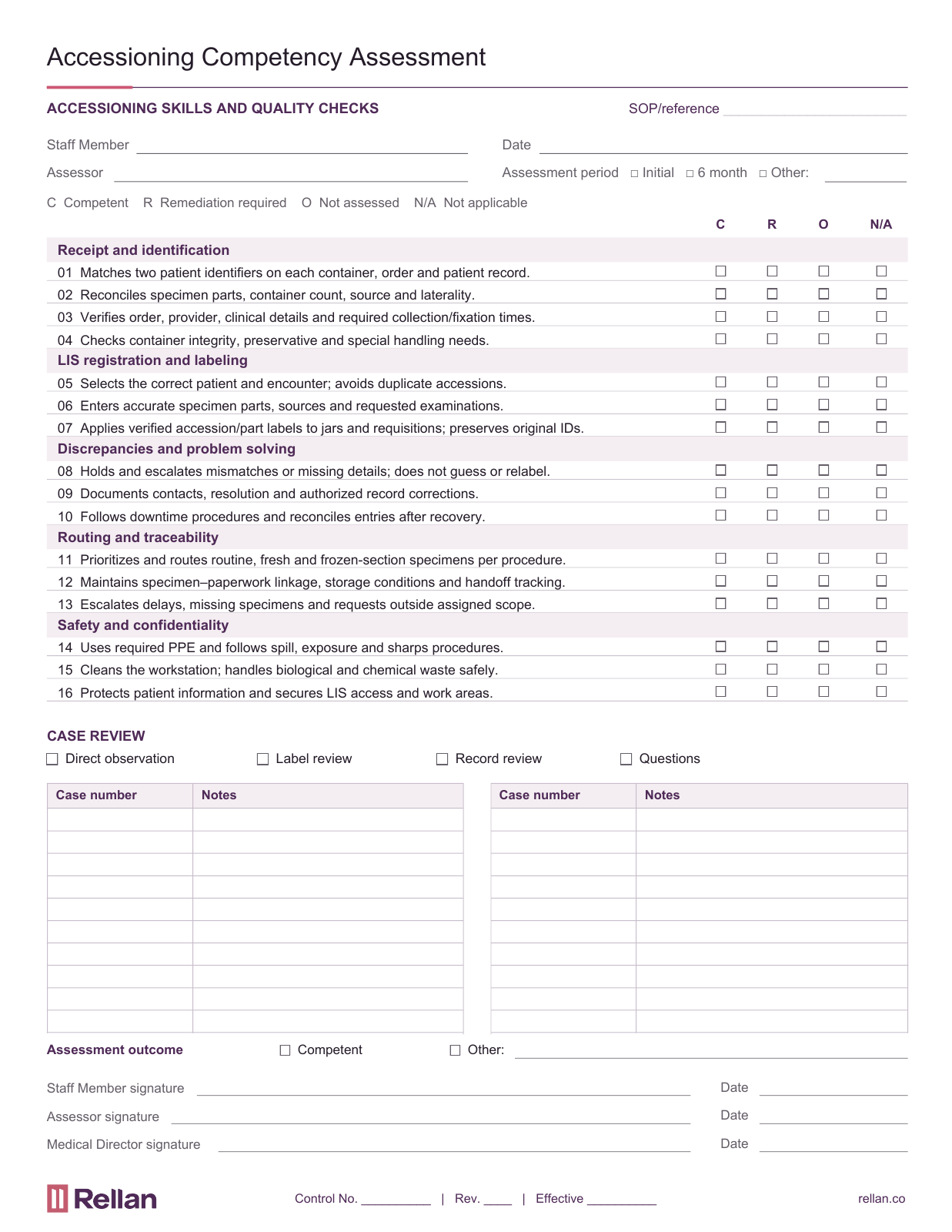
Accessioning Competency Assessment
Specimen receipt, identification, registration, labeling, discrepancy resolution, and routing, with case review.
Preview assessment
Select a page to open the full PDF.
CLIA requires documented competency assessment for personnel performing moderate- or high-complexity testing at least semiannually during their first year of patient testing and at least annually thereafter (42 CFR §§ 493.1413(b)(8)–(9) and 493.1451(b)(8)–(9)). Assessments must address the six specified evaluation methods. CAP accreditation adds checklist requirements addressing coverage by test system, assessor qualifications, supporting records, and grossing-specific oversight. Requirements depend on the duties performed: CMS distinguishes gross examination from preparation-only activities such as embedding, paraffin sectioning, and slide staining. Use these templates with your laboratory’s written procedures and applicable current requirements.
This is a reference index for general personnel and anatomic pathology competency programs—not an exhaustive reproduction of CAP requirements. Summaries below are not CAP quotations unless expressly marked. CAP updates its checklists annually and customizes inspection checklists to the laboratory’s testing menu. Verify the current requirement, notes, evidence of compliance, and cross-references in the laboratory’s assigned edition.
CAP — accreditation checklists and access
GEN.55450
Rellan summary Document preparation for the assigned work before patient testing.
In practice Initial training and ongoing competency assessment serve different purposes; completing training does not replace subsequent competency assessments.
GEN.55500
Brief excerpt from CAP’s public 2021 training material“assessed using all six elements (as applicable) on each test system”
In practice Address all six applicable assessment elements for each person and each defined test system, including relevant backup methods. Record the skills assessed and retain supporting evidence. A departmental label alone does not establish which systems were assessed.
GEN.55505
Rellan summary CAP’s public checklist guidance describes first-year assessments within seven months and no later than twelve months from the start of testing, followed by annual assessments.
In practice Performance problems also trigger reassessment. For implementation, reconcile these details with CLIA’s semiannual first-year rule and the applicable current checklist.
CAP checklist-update webinar — October 2021, pages 6–7 · 42 CFR § 493.1451 — current eCFR
GEN.55510
Rellan summary A manager title alone does not establish eligibility to assess competency.
In practice Confirm the assessor’s qualifications for the testing involved and document delegation. Personnel rules changed in December 2024, so older assessor-qualification charts should not be used without review.
CAP TODAY — personnel changes, December 2024 · CAP TODAY — observation and records, December 2025
ANP.11640; related ANP.11605
Rellan summary The CAP/NSH surgical specimen guide links grossing competency to pathologist review, defined specimen types and activities, and appropriate supervision.
In practice Its guidance includes annual review of a non-pathologist’s gross-examination performance. Read the current ANP requirement together with the general testing-personnel competency schedule; annual grossing review is not a reason to omit first-year assessments.
CAP/NSH specimen-handling guide — March 2025, page 27 · 42 CFR § 493.1451 — current eCFR
GEN.20377; related personnel-record requirements
Rellan summary Maintain accessible competency records, including the observer’s sign-off and evidence of the assessor’s qualifications.
In practice CAP’s December 2025 guidance also explains conditions for live virtual observation; prerecorded demonstrations are not a substitute for direct observation.
ADDITIONAL EDITION-CHECK ITEMS
Rellan summary The following established identifiers require a current-edition cross-check.
In practice The historical sources linked here establish the topics, but do not certify their wording or applicability in a current inspection edition.
Historical CAP Laboratory General checklist — August 2016; not a current-edition substitute · Historical CAP Anatomic Pathology checklist — April 2014; not a current-edition substitute
For laboratories performing waived testing, also review GEN.55499. Cytology, point-of-care testing, biorepositories, and other services can introduce additional checklist requirements. This page does not claim to enumerate those specialty programs.
CAP TODAY — waived-testing changes, August 2023 · CAP — accreditation checklists and access
Suggested documentation—not a quoted universal form requirement: identify the staff member, assessed duties or test systems, assessment period, methods used, supporting records, assessor and authorization, outcome, and any corrective action or reassessment. Separate forms by work area may improve usability, but the number of forms is not the measure of a complete program.
Complete the CAP edition cross-check, add any applicable specialty and state requirements, and review the references with the laboratory director or a qualified accreditation specialist. Templates support documentation; they do not independently establish qualifications, authorize practice, or guarantee inspection compliance.
Source research reviewed October 3, 2026 · CAP edition check pending · General personnel and surgical pathology/histology
Core federal provisions and CMS interpretations relevant to a laboratory competency program. “Regulation” and “CMS guidance” are distinguished below. The source links open the complete regulatory sections or guidance documents; displayed quotations are brief excerpts, not the full provisions. This is not an inventory of every use of “competency” throughout all CLIA materials.
REGULATION · 42 CFR § 493.1235
Excerpt“the laboratory must establish and follow written policies and procedures to assess employee and, if applicable, consultant competency.”
In practice The laboratory needs a written assessment process, not simply a collection of blank forms. Subpart M supplies the relevant personnel responsibilities.
REGULATION · 42 CFR §§ 493.1413(b)(8) and 493.1451(b)(8)
Rellan summary These parallel moderate- and high-complexity provisions address:
In practice These are paraphrases. Follow the full text and applicable CMS guidance when determining how each method applies to a particular procedure.
42 CFR § 493.1413 — current eCFR · 42 CFR § 493.1451 — current eCFR
REGULATION · 42 CFR §§ 493.1413(b)(9) and 493.1451(b)(9)
Two excerpts from § 493.1451(b)(9)“at least semiannually during the first year the individual tests patient specimens”
“Thereafter, evaluations must be performed at least annually”
In practice The provisions also require reevaluation for a changed testing method or instrument before patient results are reported using it.
42 CFR § 493.1451 — current eCFR · 42 CFR § 493.1413 — current eCFR
REGULATION · 42 CFR § 493.1445(e)(12), (13), and (15)
Rellan summary Before patient testing, personnel must have appropriate qualifications, training, and demonstrated reliable performance.
In practice The director must ensure monitoring across all testing phases, identify remedial-training needs, and specify each person’s authorized work, required supervision, and any required pre-report review.
REGULATION · 42 CFR § 493.1407(e)(11), (12), and (14)
Rellan summary These provisions address readiness for testing and continuing competency monitoring.
In practice The director’s responsibilities also include remedial training and written authorization and supervision of assigned work.
REGULATION · 42 CFR § 493.1463(b)(4)
Full text of subparagraph (b)(4)“Evaluating and documenting the competency of all testing personnel.”
In practice Read this with the introductory language of paragraph (b): the director or technical supervisor may delegate this responsibility to the general supervisor. Eligibility and specialty-specific requirements still matter.
CMS GUIDANCE · Competency brochure, May 2025, page 8
Excerpt“a competency assessment isn’t required by regulation for non-testing personnel”
In practice CMS gives accessioning staff and people who only label or process samples as examples. This does not eliminate the director’s responsibility to monitor competency across testing phases. Do not label an annual or semiannual preparation-only assessment schedule as a universal CLIA requirement. A laboratory may adopt a broader program under its own policy, and other applicable requirements must still be checked.
CMS competency brochure — May 2025 · 42 CFR § 493.1445 — current eCFR
CMS GUIDANCE · State Operations Manual, Appendix C
Rellan summary Under the interpretation of § 493.2, embedding tissue cassettes, sectioning paraffin blocks, and staining slides are preparatory activities.
In practice The histopathology guidance distinguishes these from gross examination and diagnostic microscopic evaluation. Determine the applicable personnel rules from actual assigned duties, not the job title or the name of the department.
CMS State Operations Manual, Appendix C — revision 233, September 12, 2025
CMS GUIDANCE · Competency brochure, May 2025
Rellan summary Training documents instruction; competency assesses ongoing performance.
In practice Supervisory and consultant assessments should address their regulatory responsibilities. When those personnel also perform patient testing, their testing duties require the applicable testing-personnel assessment as well.
ADDITIONAL FEDERAL SCOPE CHECK
Rellan summary Provider-performed microscopy has specific competency provisions in § 493.1359(c)–(d). Cytology adds specialty requirements, including workload reassessment under § 493.1451(c)(3) and individual proficiency testing under § 493.855.
In practice A cytology workload review is not interchangeable with a general competency assessment.
Specimen receipt, identification, registration, labeling, discrepancy resolution, and routing, with case review.
Select a page to open the full PDF.
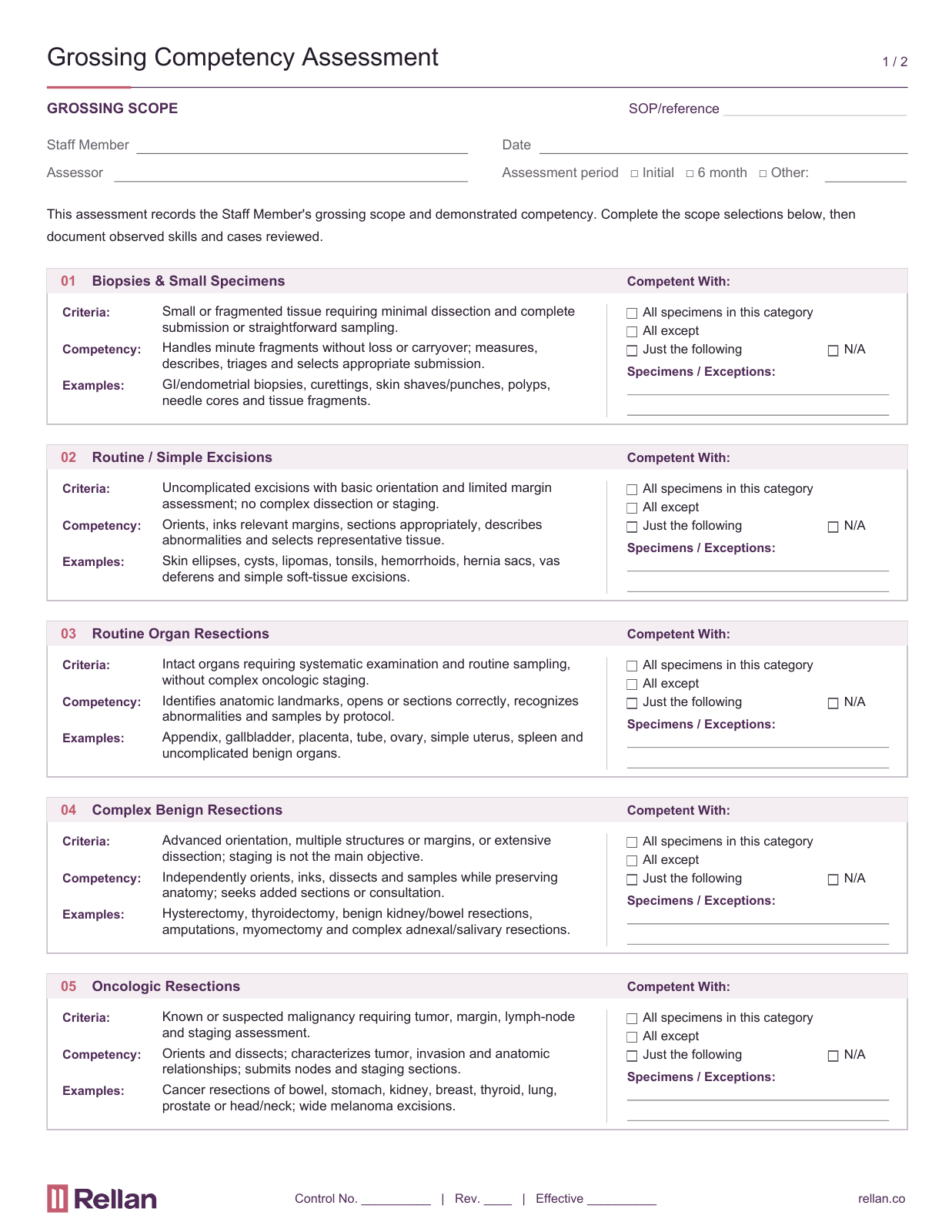
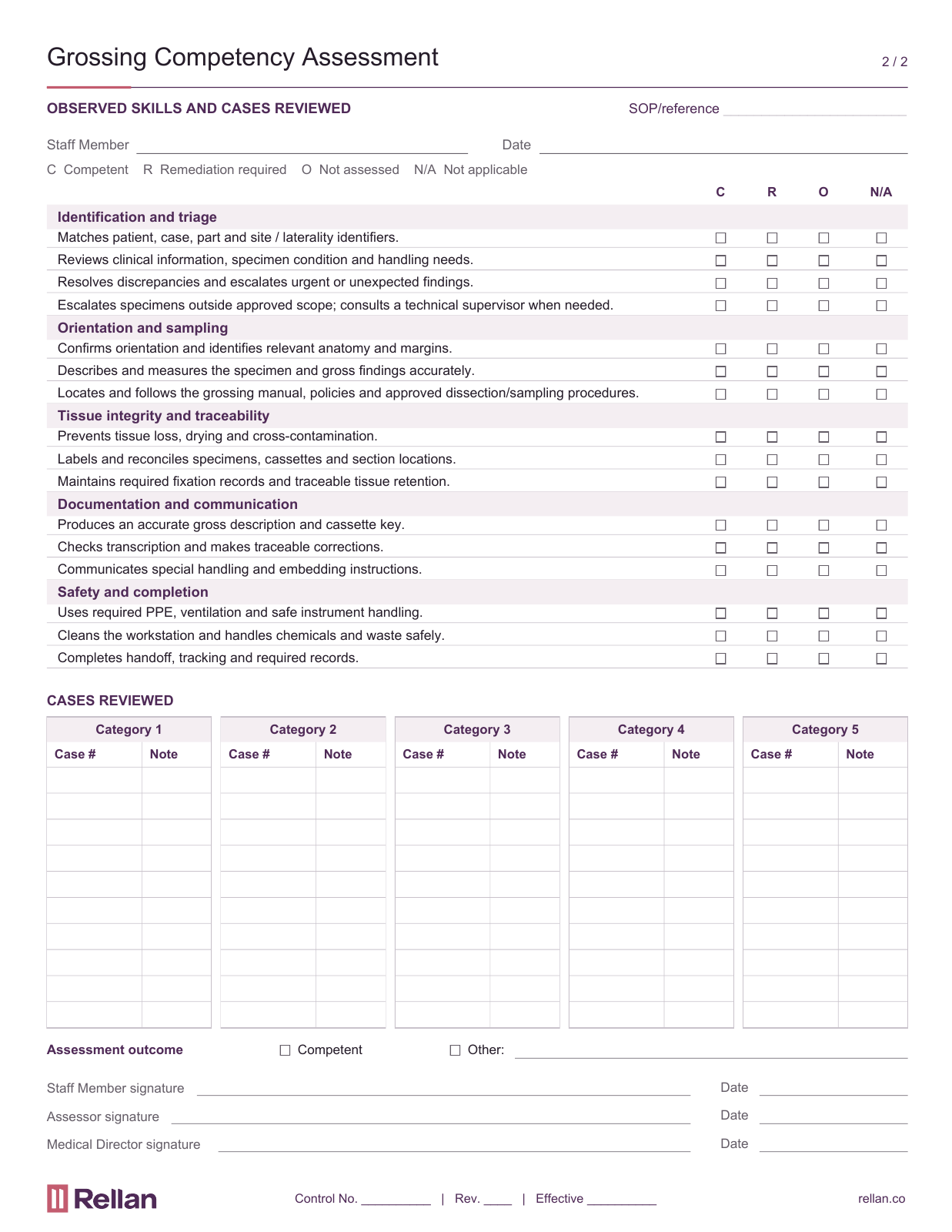
Observed grossing skills and case review across five specimen categories.
Select a page to open the full PDF.
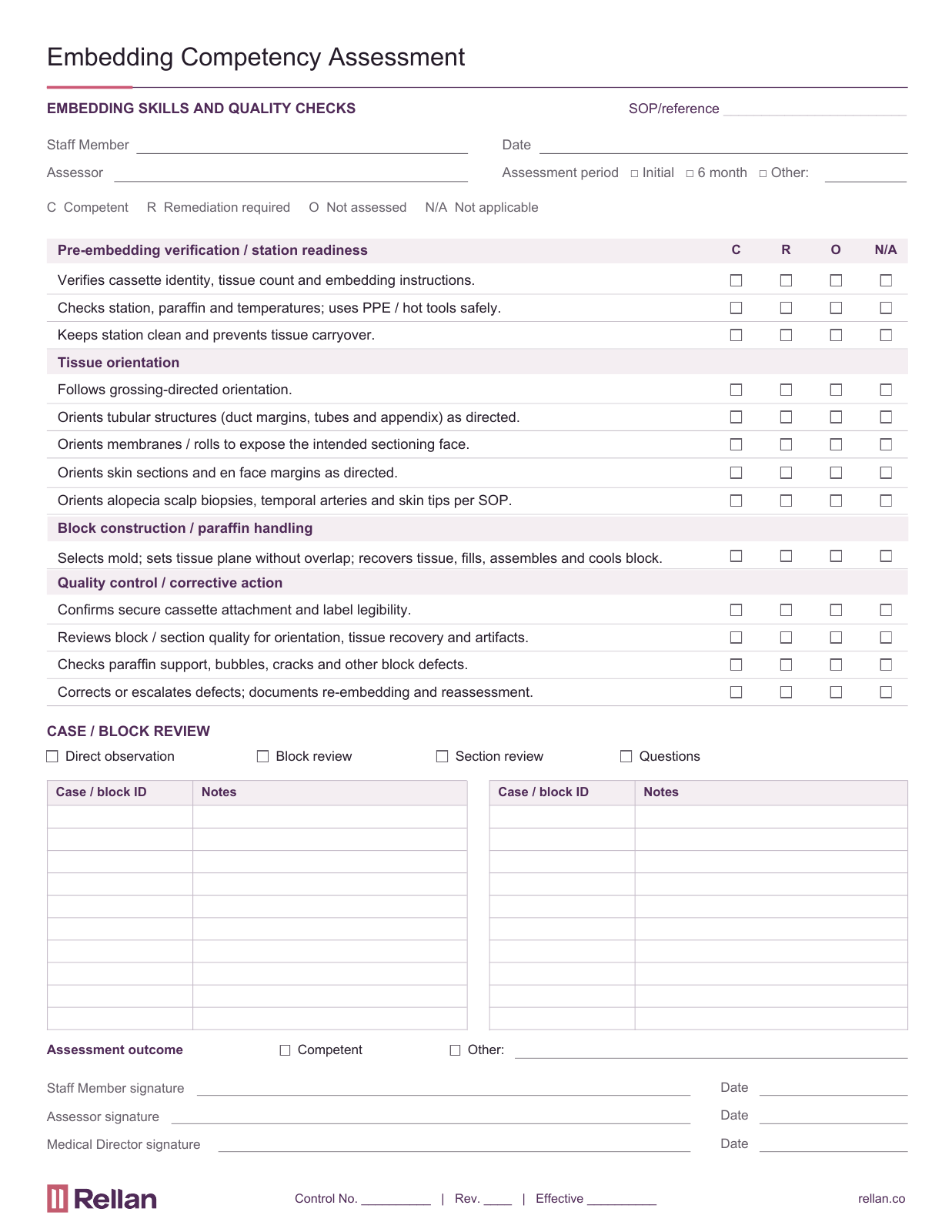
Pre-embedding checks, tissue orientation, block construction, and quality control, with case and block review.
Select a page to open the full PDF.
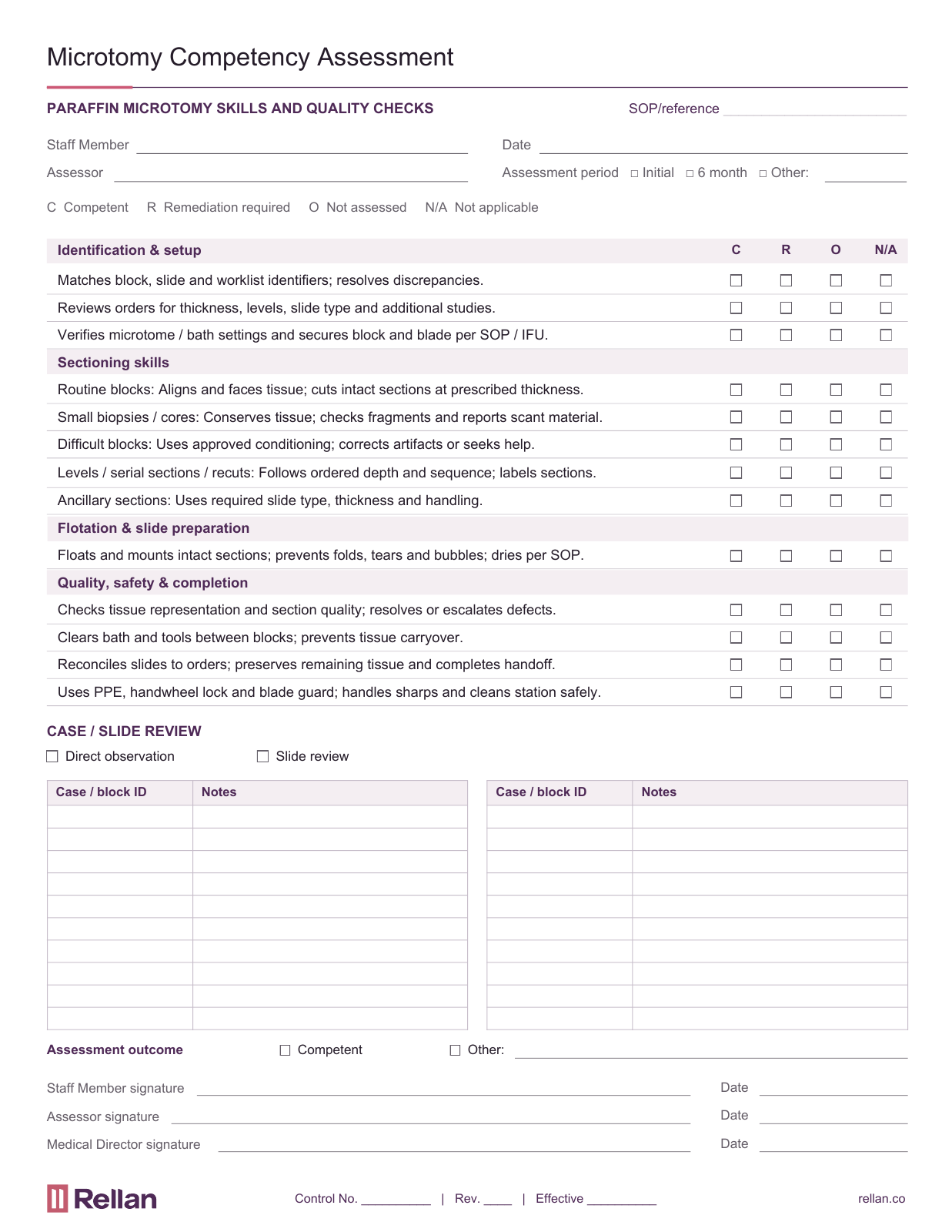
Paraffin sectioning, flotation, slide preparation, and quality checks, with case and slide review.
Select a page to open the full PDF.
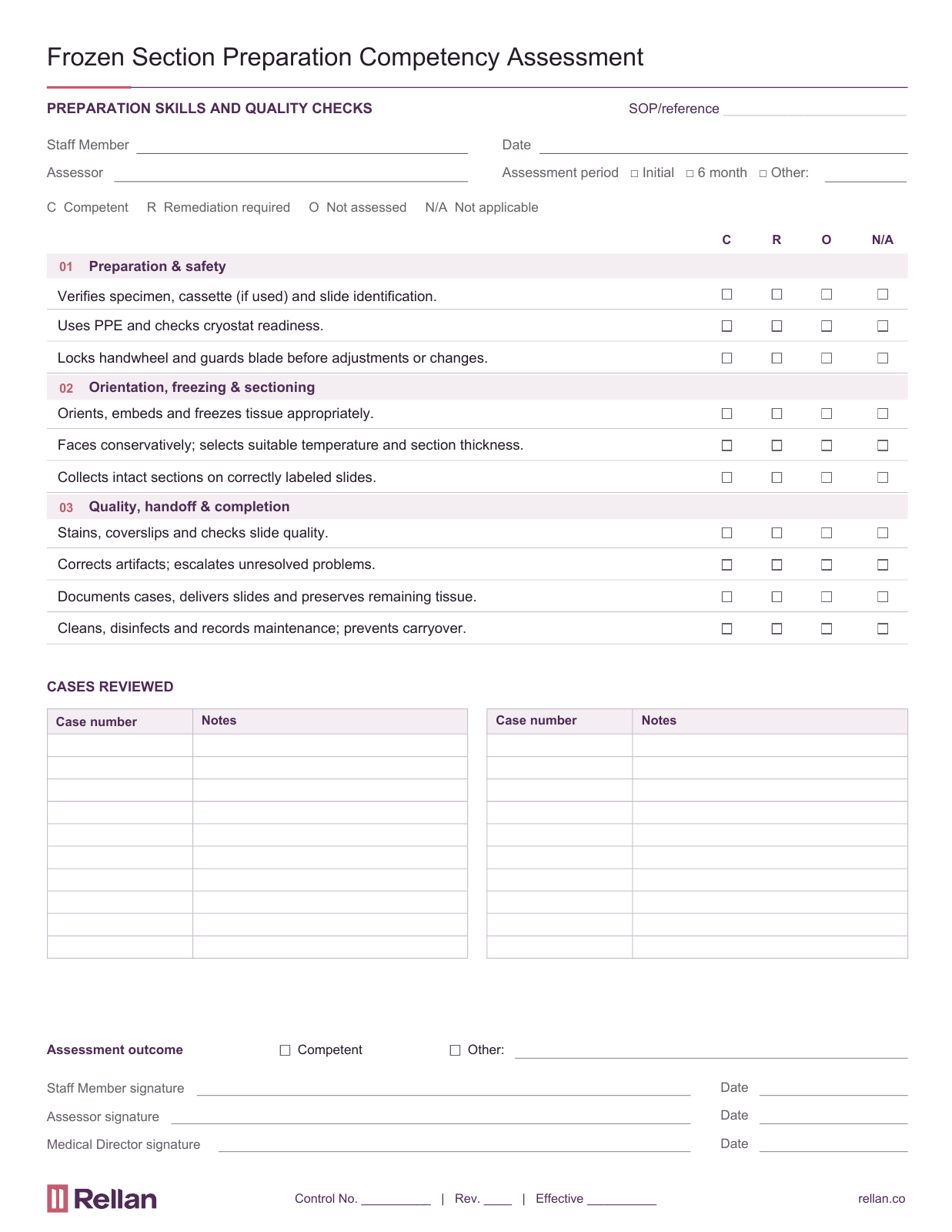
Cryostat safety, tissue orientation, freezing, sectioning, and slide quality, with case review.
Select a page to open the full PDF.